

At Colegio Internacional San Cristóbal, students can take the Baccalaureate through the Diploma Programme (DP) of the International Baccalaureate: two demanding years with an international outlook that complete the IB continuum our students begin at the age of 3. On completion, they obtain the IB Diploma and direct access to university.
Ages 16 to 18
Final two years of school
5 subject groups
Plus TOK, Extended Essay and CAS
Personal tutor
Individual follow-up
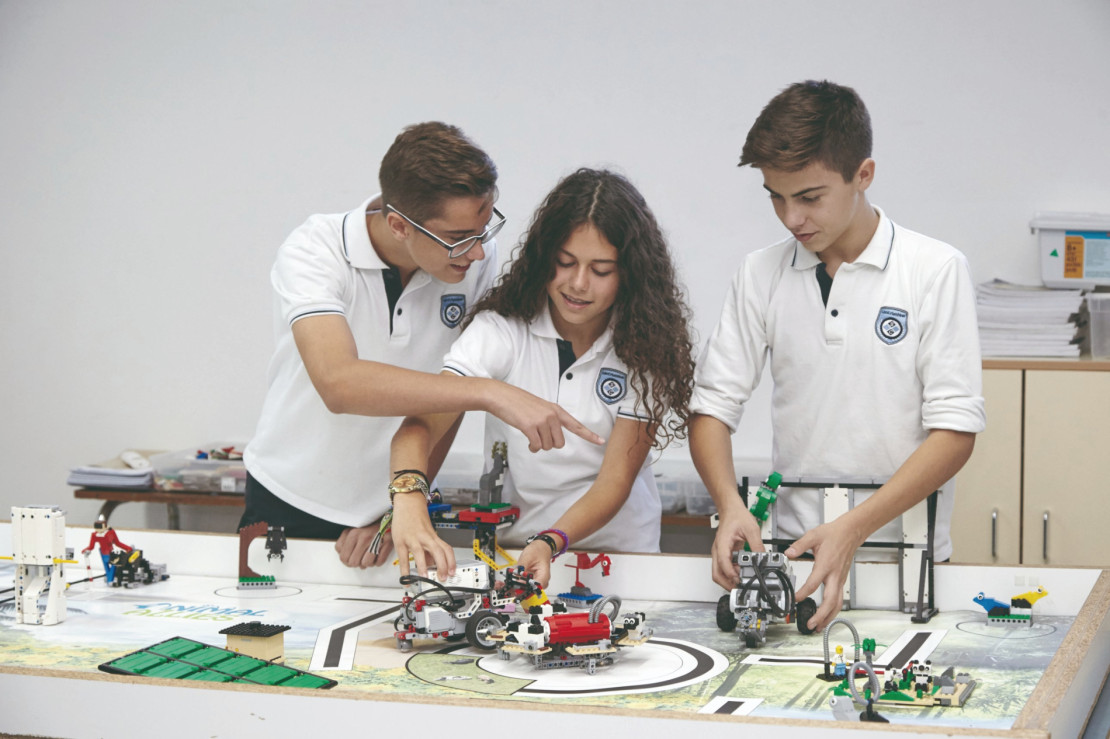
We are an IB World School authorised for all three IB school programmes. The Diploma Programme is the final stage. Students who join from our MYP are already familiar with inquiry, criterion-based assessment and independent work. Students who join from another school are supported by their tutor and the Counselling Department from day one.
PYP
Ages 3 to 12
MYP
Ages 12 to 16
DP · You are here
Ages 16 to 18
It is a two-year curriculum from the International Baccalaureate Organization. It combines six subjects studied in depth with three core components that every student completes. These components develop critical thinking, research skills and commitment to the community.
Students reflect on how we know what we know. They analyse knowledge in each subject and learn to argue with sound judgement.
An independent research paper of up to 4,000 words on a topic chosen by the student, guided by a supervisor. It is the best preparation for university-level work.
Throughout the programme, students take part in artistic, sporting and community service projects, so they also grow outside the classroom.
Each student takes six subjects, at least one from each group. At least three, and up to four, are studied at Higher Level (HL), in greater depth and with more teaching hours; the rest at Standard Level (SL).
Group 1
Spanish A (HL).
Group 2
English B (SL).
Group 3
History (SL), Business Management (HL) and Environmental Systems and Societies, ESS (SL).
Group 4
Biology (HL), Chemistry (SL), Physics (SL) and Environmental Systems and Societies, ESS (SL).
Group 5
Analysis and Approaches (SL and HL) and Applications and Interpretation (SL).
Each subject is graded from 1 to 7. TOK and the Extended Essay add up to 3 more points, for a maximum of 45. The final grade combines coursework assessed at school and external exams at the end of the second year, marked by IB examiners around the world.
The choice of subjects and levels depends on what the student wants to study afterwards. The Counselling Department works it out with each student and their family before the first year begins. More about the programme on the IB website.
Under Royal Decree 534/2024 (in Spanish), IB Diploma holders can enter Spanish universities without taking the compulsory part of the PAU, the Spanish university entrance exam, and without having their qualification recognised.
UNEDasiss certifies the entrance grade that gives access to university. With this certification, students apply for the degrees of their choice, just like any other student.
The Diploma is recognised in more than 150 countries and valued by more than 2,000 universities worldwide, such as Harvard, Oxford, the Complutense University of Madrid and Pompeu Fabra University in Barcelona.
The Counselling Department supports each student with subject choices, UNEDasiss certification and applications to each university.
Entrance is not the same as admission. The Diploma opens the door to university; a place on each degree depends on the student’s grades and on each university’s criteria. That is why we plan university entrance from the first year.
The IB authorises and regularly evaluates our Diploma Programme.
Official IB profile →Our students consistently achieve results above the IB world average.
Our Diploma teachers are trained by the IB and keep their training up to date.
Tutors, the programme coordinator and the Counselling Department closely follow each student’s progress over the two years.
San Cristóbal was founded as an educational institution in 1970. We are a family-run private school in Castellón.
Two demanding years call for more than study. We help students manage stress and exam pressure, build self-confidence and make decisions about their future.
Both options prepare students for university. The choice depends more on the student than on their grades: on how they like to work and where they want to study afterwards.
| IB Diploma Programme | Spanish Baccalaureate | |
|---|---|---|
| Curriculum | Five subject groups plus TOK, the Extended Essay and CAS | One track, with core, track-specific and elective subjects |
| Assessment | Internal coursework and external IB exams; scored from 1 to 45 | Continuous assessment by the school; Baccalaureate average mark |
| University entrance in Spain | Without the university entrance exam (PAU) | Through the university entrance exam (PAU) |
| Qualification | IB Diploma, recognised in more than 150 countries | Spanish Bachiller qualification |
| Who it suits | Students who do best with a more independent method: research, written work and critical thinking in every subject | Students who do best with a more traditional method: classroom teaching, subject-by-subject study and exams in each assessment period |
Visit the school and talk to the programme team about your child. Book a visit or call us on +34 964 228 758.
SCHOOL
Tel. +34 964 228 758
Calle San Jorge del Maestrazgo, 2
12003 Castellón de la Plana
NURSERY SCHOOL
Tel. +34 964 228 758
Calle Moncófar,6
12003 Castellón de la Plana
© 2026 San Cristóbal Educational Centers.


