Second Cycle Early Childhood and Primary Education (PYP)
IB World School · Ages 3 to 12
Early Years and Primary Education in Castellón with the IB Primary Years Programme
At Colegio Internacional San Cristóbal, the three years of second-cycle Early Years and the six years of Primary follow the Primary Years Programme (PYP) of the International Baccalaureate. Pupils learn through inquiry: they investigate real questions and connect subjects, while following the full official Valencian curriculum.
The PYP is the International Baccalaureate (IB) programme for children aged 3 to 12. It does not replace the official curriculum: it is a framework that shapes how teaching and learning happen.
At San Cristóbal, the content of the Valencian curriculum is taught through units of inquiry: each unit is built around a big idea and connects language, maths, science, social studies, art and physical education. This way, what pupils learn makes sense to them, and they remember it.
The aim is not just to know more, but to learn how to think: asking good questions, looking for answers, working with others and explaining what they have discovered.
An evaluated programme: the school is authorised by the International Baccalaureate Organization, which regularly reviews how the programme is implemented at the school.
Unit of inquiry
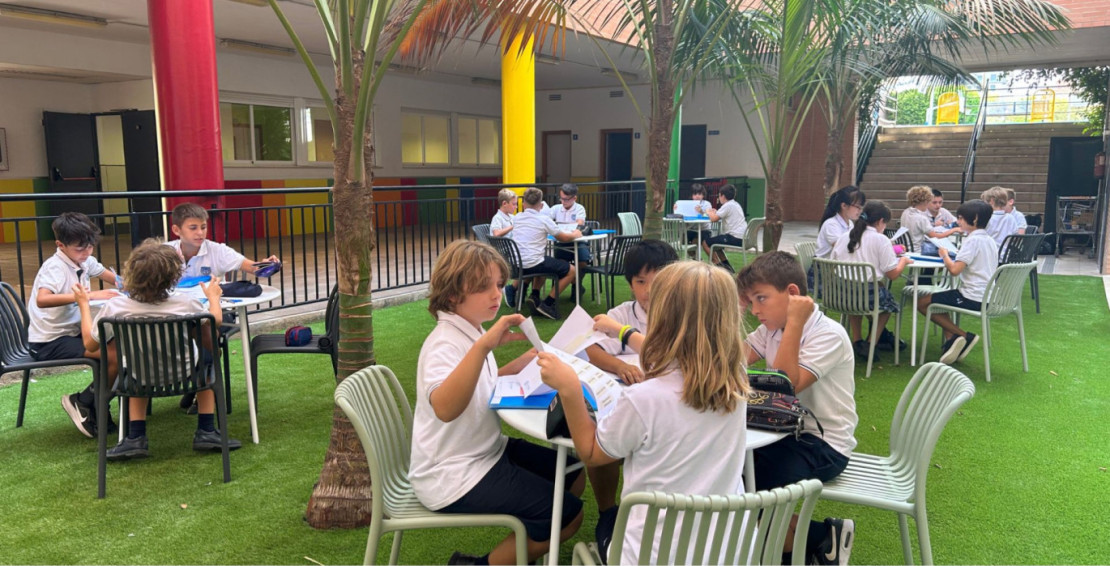
Designing a model of a sustainable town as a team: maths, science and social studies in a single project.
How pupils learn
Inquiry, step by step
Learning through inquiry means pupils are not handed ready-made answers: they build them. The teacher designs the unit, sets challenges and guides the process.
1
A question that matters
Each unit starts from a central idea and from the pupils’ own questions.
2
Investigate and experiment
They observe, look for information, test and compare ideas, with the teacher as a guide.
3
Create and apply
What they learn becomes something concrete: a model, an experiment, a proposal for their community.
4
Share and reflect
They present their work, explain how they did it and consider what they have learnt and what they would improve.
Six big themes to understand the world
Each year’s units of inquiry are organised around six transdisciplinary themes, shared by every PYP school in the world.
Who we are
Identity, health, relationships and what makes us human.
Where we are in place and time
History, places, journeys and discoveries.
How we express ourselves
Ideas, feelings, culture and art.
How the world works
Nature, science and technology.
How we organize ourselves
Communities, systems and decision-making.
Sharing the planet
Resources, the environment and living together.
Two stages, one programme
From Early Years to Year 6 of Primary
The approach stays the same for nine years. What changes is how much independence is expected of each pupil.
Early YearsEarly Years · 3 years
PrimaryPrimary · 6 years
Age 36Age 12
Early Years · second cycle · ages 3 to 5
Learning through play, exploration and questions
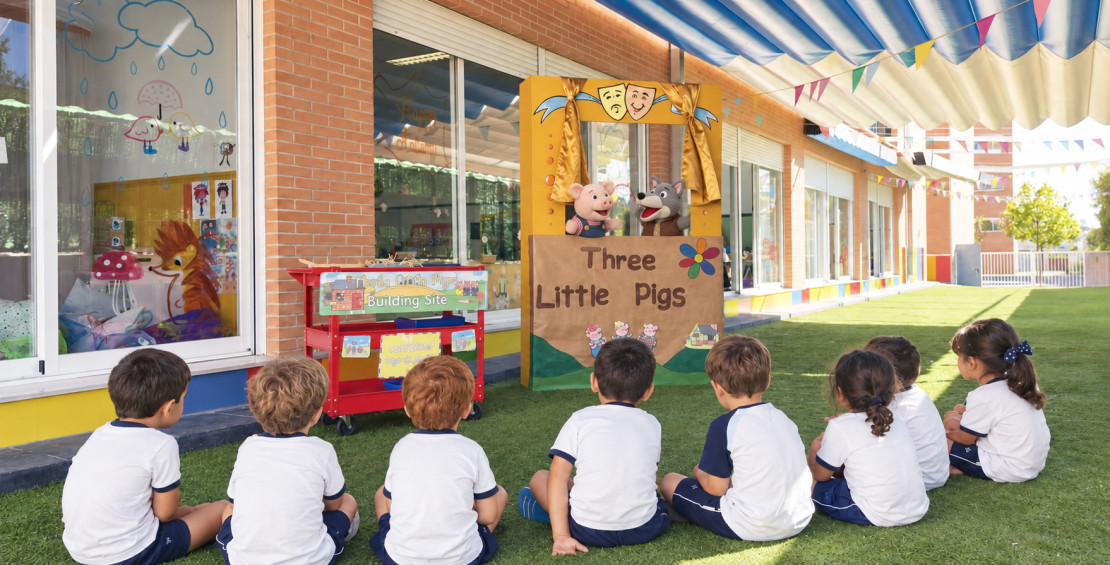
Children’s natural curiosity is the starting point. Play, observation and hands-on materials are their first ways of investigating.
Routines, independence and habits
Play and exploring their surroundings
First steps in reading and writing
English every day, with songs, games and routines
Primary Education · Years 1 to 6 · ages 6 to 12
Investigating with method and working as a team
Units of inquiry become deeper. Pupils learn to organise information, build arguments and present their work in public.
Reading and writing in three languages
Projects that connect several subjects
French in class and German as an extracurricular activity
Self-assessment and reflection on their own learning
Year 6 of Primary: the PYP exhibition
In their final year, pupils carry out their own team inquiry into a topic that matters to them and present it to the school community. It marks the end of the programme and the bridge to Secondary with the MYP.
Vocabulary, conversation and play: English is learnt by using it.
Languages
A multilingual project from age 3
Each language has a clear role in everyday school life. English is the priority language: it carries a lot of weight from Early Years and is taught intensively, with particular attention to spoken communication.
All IB programmes share the same learner profile. In the PYP it becomes everyday classroom language: children recognise it, use it to reflect on their work and take it with them to the MYP and the Diploma.
Inquirers
Curious and able to investigate.
Knowledgeable
Understand ideas across many areas of knowledge.
Thinkers
Analyse, reason and make sound decisions.
Communicators
Express themselves confidently in more than one language.
Principled
Act with honesty and a sense of fairness.
Open-minded
Value other cultures and points of view.
Caring
Show empathy and help others.
Risk-takers
Face new challenges with confidence.
Balanced
Look after their physical, mental and emotional wellbeing.
Reflective
Think about what they learn and how to improve.
Everyday life
What supports the PYP at our school
Active, cooperative classrooms and a team that knows every pupil.
Cooperative work
Pupils learn to coordinate, take on a role, listen to other opinions and resolve disagreements.
Technology with a purpose
Digital devices and computational thinking that serve learning, rather than being an end in themselves.
At first it was hard for us to understand how they worked with the PYP, because it wasn’t the way we had studied. Over time we have seen that our son asks more questions, connects ideas better and comes home talking about what he has investigated in class.
Family of a Year 3 Primary pupil
Colegio Internacional San Cristóbal
For us it has been important to feel that the school knows our daughter. It hasn’t always been easy, but whenever she has needed support we have found closeness, understanding and follow-up. That gives us great peace of mind as a family.
Family of a Year 5 Primary pupil
Colegio Internacional San Cristóbal
Information for families
Frequently asked questions about Early Years and Primary with the PYP
What is the International Baccalaureate PYP?
It is the International Baccalaureate (IB) Primary Years Programme, designed for children aged 3 to 12. It organises learning into units of inquiry that connect several subjects around a big idea. At Colegio Internacional San Cristóbal it covers the three years of second-cycle Early Years and the six years of Primary.
Does the PYP replace the official curriculum?
No. Pupils follow the full official Valencian curriculum. The PYP is the framework that defines how that curriculum is taught: through inquiry, connecting subjects and with continuous assessment.
From what age can my child join?
The PYP starts in the first year of second-cycle Early Years, at age 3, and continues to Year 6 of Primary. Children can join in any year, with a welcome process coordinated by their tutor and the Counselling Department.
In which languages do pupils learn?
Spanish is the school’s language of instruction, and Valencian, a co-official language, is present in every year. English is the priority language and is taught intensively from Early Years. French is taught in class, and German is offered as an extracurricular activity from Primary.
How are pupils assessed in the PYP?
Assessment is continuous and formative: it values the learning process, not just the final result. Pupils learn to assess themselves, and families receive regular information about their progress.
What happens if my child changes school in the future?
They can join any other school without difficulty, because they have followed the full official curriculum. They also take with them habits of independent work, research and public speaking that will help them at any school.
What comes after the PYP?
After Year 6 of Primary, pupils continue at the same school with Secondary Education (ESO) and the IB Middle Years Programme (MYP). They can then choose between the Diploma Programme, the Spanish Baccalaureate or Vocational Training.
How much do Early Years and Primary cost at Colegio Internacional San Cristóbal?
It is a private school, and fees depend on the year and the services chosen, such as lunch or transport. The school offers Academic Excellence Scholarships (in Spanish). For up-to-date information, contact our admissions team or call +34 964 228 758.
Come and see the PYP in the classroom
The best way to understand how our pupils learn is to see it. Book a guided visit or call us on +34 964 228 758.